React Backend Integration Made Easy: Build and Connect APIs Faster
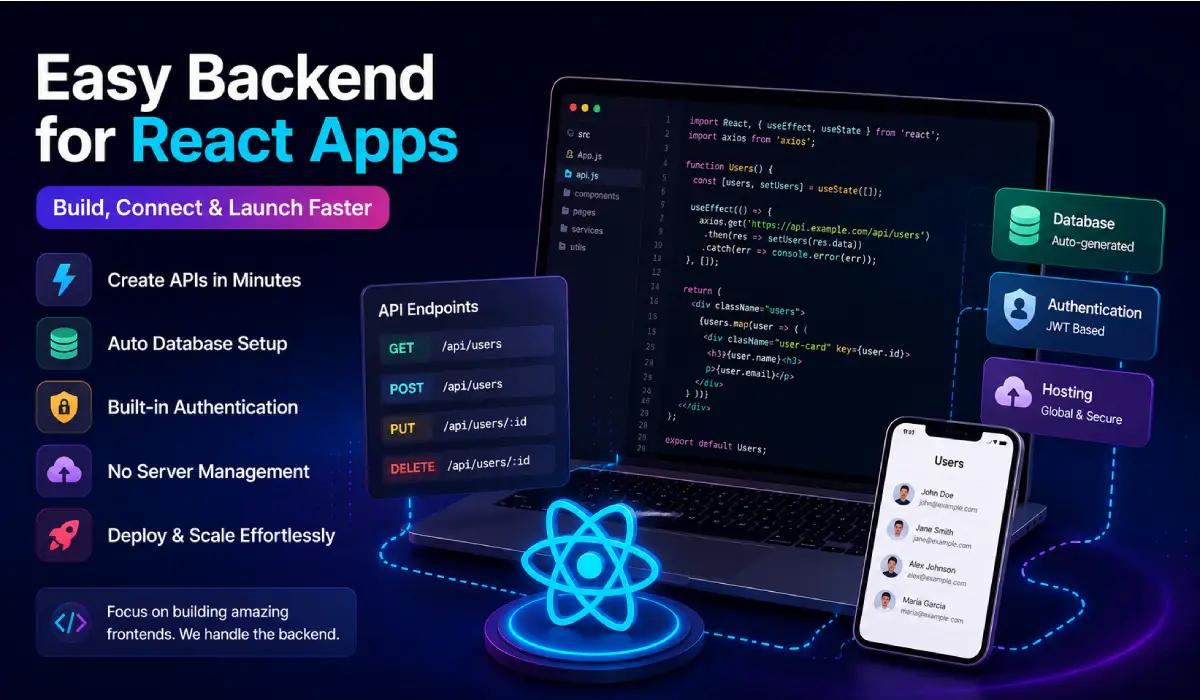
React backend integration is now much easier with modern backend platforms that help developers quickly connect APIs, manage databases, and handle authentication without complex server setup. Instead of spending weeks configuring infrastructure, developers can now create a backend for React apps, simplify React app backend setup, and launch full-stack applications faster with ready-to-use API solutions.
Building a beautiful React frontend is easy. But the moment you need real data, authentication, or database storage, things suddenly get complicated. That is why many developers struggle with React backend integration and figuring out how to connect a React app to a real API without spending weeks learning backend development.
The good news? Modern tools now make it possible to create a backend for React apps in minutes instead of days. Without managing servers, writing complex APIs, or handling databases manually, frontend developers can finally focus on building products faster.
In this guide, you will learn the easiest way to connect your React app to an API, simplify your React app backend setup, and discover why platforms like EazeMyAPI are becoming a popular backend platform for React developers in 2026.
Why React Developers Need a Simple Backend?
React makes frontend development fast and flexible, but every real application still needs a backend to handle data, authentication, APIs, and user management. That is where many developers face challenges.
Setting up servers, creating REST APIs, managing databases, and handling authentication can take more time than building the actual React frontend. For frontend-focused developers, this adds complexity, slows development, and increases the learning curve.
This is why many developers now look for a simpler backend for React apps that helps them focus on building features instead of managing infrastructure. A simple backend speeds up React API integration, reduces setup time, and makes it easier to connect a React app to a real API without deep backend knowledge.
Common Problems With Backend Setup in React Apps
Building the frontend in React is usually the easy part. The real challenge starts when developers need to create and connect a backend. From APIs and databases to authentication and deployment, backend setup can quickly become overwhelming, especially for frontend-focused developers.
Some of the most common problems with React backend integration include:
- Setting up servers and backend frameworks like Node.js or Express
- Creating and managing REST API endpoints manually
- Configuring databases and handling data relationships
- Managing authentication systems and JWT tokens
- Handling deployment, hosting, and environment variables
- Writing backend logic for CRUD operations
- Debugging API connection and CORS errors
- Maintaining backend security and scalability
- Spending more time on setup than actual product development
These challenges are why many developers now prefer faster and simpler ways to create a backend for React apps without managing complex infrastructure.
What You Need Before Connecting a React App to an API?
Before starting React API integration, you need a few basic things ready to make the connection smooth and error-free. The good news is that you do not need deep backend knowledge to get started.
Here are the essentials you need before you connect your React app to an API:
- A React application is already set up
- A working API or backend endpoint
- API access credentials or authentication token (if required)
- An HTTP client like Fetch API or Axios
- Basic understanding of API requests like GET, POST, PUT, and DELETE
- Internet connection between the React frontend and the backend server
- Proper API documentation to understand available endpoints
Once these basics are ready, the process of React backend integration becomes much faster and easier.
How to Connect Your React App to a Real API?
The process of React backend integration is much simpler than many developers think. Once your backend is ready, your React app simply sends requests to API endpoints and displays the returned data on the frontend.
Here is the basic process to connect a React app to a real API:
-
Get Your API Endpoint
Your backend provides API URLs that your React frontend can connect to for fetching or sending data.
Example:
https://api.example.com/users -
Use Fetch or Axios
React apps usually connect to APIs using Fetch API or Axios to make HTTP requests.
Example:
axios.get("/users") -
Handle API Responses
Once the API responds, React displays the data dynamically inside components.
-
Add Authentication
For secure apps, authentication systems like JWT tokens are used to protect API access and user data.
-
Connect Everything Together
After the connection is complete, your React app can manage users, display live data, submit forms, and perform CRUD operations through the backend API.
For developers who want a faster setup, platforms like EazeMyAPI simplify the process by generating APIs, database setup, and authentication automatically, helping frontend developers build backend systems in minutes instead of days.
What is EazeMyAPI, and How Does it Help with Backend Set-Up?
EazeMyAPI is a backend platform designed for frontend developers who want to build full-stack applications without managing complex backend infrastructure.
Instead of manually setting up servers, databases, authentication systems, and API endpoints, developers can simply describe what they need in plain English. The platform then generates a production-ready backend automatically.
This helps simplify the entire React app backend setup process.
With EazeMyAPI, developers can:
- Generate REST API endpoints instantly
- Create databases without writing SQL
- Add authentication and user management quickly
- Skip server configuration and DevOps setup
- Connect React apps to APIs faster
- Build backend systems in minutes instead of weeks
For React developers, this means less time spent on backend configuration and more time focused on building the frontend experience.
Firebase vs Supabase vs EazeMyAPI for React Apps
Choosing the right backend as a service platform for React developers depends on how much backend control, setup simplicity, and scalability you need. While Firebase and Supabase are popular choices for React backend integration, many frontend developers still spend time configuring databases, authentication, permissions, and backend logic.
That is why newer platforms focused on faster React app backend setup are gaining attention. The goal is simple: help developers connect React apps to APIs and launch products faster without managing backend complexity.
| Feature | Firebase | Supabase | EazeMyAPI |
| Backend Type | Backend as a Service (BaaS) | Open-source BaaS | AI-powered backend platform |
| Database | NoSQL (Firestore) | PostgreSQL | Auto-generated relational database |
| API Generation | Limited auto APIs | Auto-generated REST APIs | Instant REST API endpoints |
| Authentication | Built-in | Built-in | Built-in JWT authentication |
| Server Management | Minimal | Minimal | No server management |
| Setup Complexity | Medium | Medium | Very low |
| Best For | Real-time apps | SQL-based apps | Fast backend creation for frontend developers |
| Backend Knowledge Required | Moderate | Moderate | Beginner-friendly |
| Speed of Setup | Fast | Fast | Build backend in minutes |
| Ideal Users | Full-stack developers | Developers comfortable with SQL | Frontend and React developers |
How API Integration Speeds Up React Development?
React development becomes much faster when developers can create REST APIs without writing back-end code for every backend feature from scratch. Instead of spending days setting up servers, databases, authentication systems, and API routes, modern API integration allows developers to connect their frontend directly to ready-to-use backend services.
With faster API integration, React developers can:
- Build and test features more quickly
- Reduce backend setup time
- Focus more on UI and user experience
- Launch MVPs faster
- Scale applications more efficiently
- Simplify ongoing maintenance
Instead of managing infrastructure, developers can spend more time improving the actual product experience.
Final Thoughts
Building a React app should feel exciting, not slowed down by backend complexity. Today, developers want faster workflows, simpler tools, and the ability to move from idea to production without spending weeks configuring infrastructure.
That is exactly why modern backend platforms are changing how full-stack applications are built. Instead of getting stuck managing servers, databases, and authentication, frontend developers can now focus more on creating better product experiences and shipping faster.
At EazeMyAPI, we built the platform with that same mindset, helping React developers simplify backend setup and connect their apps to real APIs without the traditional learning curve. Check it out and test for free.
If you already know React, building a complete full-stack application is probably much easier than you think.
FAQs
How do I connect a React app to an API?
To connect a React app to an API, developers usually use Fetch API or Axios to send HTTP requests to backend API endpoints and display the returned data inside React components.
What is the best backend for React developers?
The best backend for React developers depends on project needs, scalability, and ease of setup. Many developers prefer backend platforms that simplify API creation, authentication, and database management.
Can frontend developers build a backend for React apps?
Yes. Modern backend platforms now allow frontend developers to create a backend for React apps without deep backend knowledge or complex server configuration.
Do I need Node.js to connect React to an API?
No. You do not always need Node.js for React backend integration. React apps can connect to any backend or API service that provides accessible API endpoints.
What is the easiest way to create APIs for React apps?
The easiest way is to use backend platforms that automatically generate REST APIs, authentication, and database setup, helping developers build APIs much faster.
Which backend platform is best for React beginners?
Beginner-friendly backend platforms are usually those that require minimal setup, no server management, and simple API integration workflows for React apps.
How can I build a backend without managing servers?
You can use serverless or Backend-as-a-Service (BaaS) platforms to build a backend without handling servers, infrastructure, deployment, or DevOps management manually.
Ready to build your backend?
Create your first project for free. No credit card required.
Get started free